



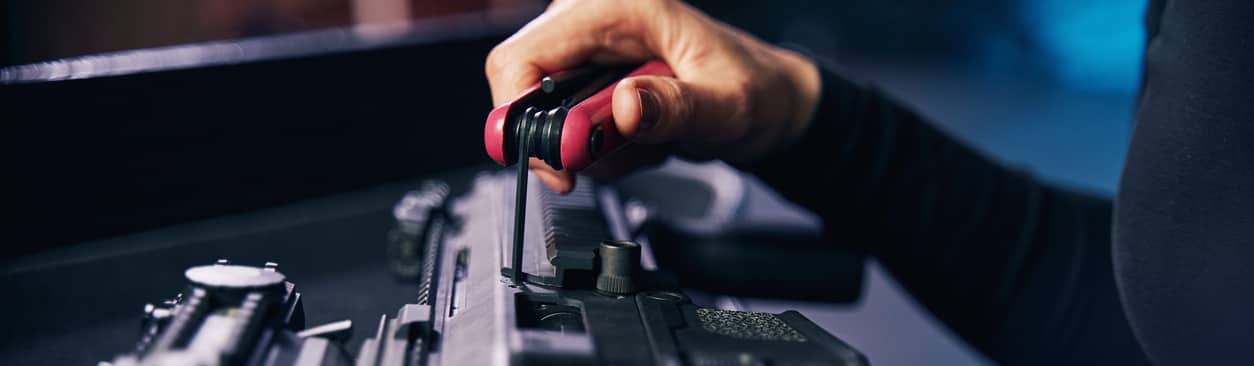
As with any mechanical device, your AR requires regular maintenance and cleaning. How much cleaning is determined by how much you shoot and the conditions in which you are shooting. While some may argue that these rifles don’t need to be cleaned after each shooting session, I encourage it. This is especially true if this gun is a personal defense firearm.
Cleaning your gun is not complicated and can be accomplished by following a few easy steps. Get your cleaning supplies together in a well-ventilated area and make sure you have a mat or protective cloth for your table or counter. Once everything is organized, you can get to work. Here are the basic steps.
Items you will need:
• A cleaning rag
• Cleaning patches
• A cleaning rod or cable
• A toothbrush or gun-cleaning brush
• Cleaner and/or lubricant, many of which are now combined into one formula
Safety First
To begin, remove the magazine and empty it. Place the loose ammo out of your work area. Clear the chamber and check it multiple times. Finally, verify that the mag well and chamber are empty and free of ammunition. This step must be followed each and every time you clean your guns.
Break It Down
In most cases, a simple field stripping is sufficient for your needs. While your owner’s manual will have detailed instructions on this process, let’s look at the basics. For general cleaning, you will just remove the bolt carrier group (BCG), and separate the upper and lower receivers to allow easier access. Let’s start with the upper and lower.
Begin by pressing the rear detent pin. Now finish pulling it from the other side. The pin will stop once it has cleared the interior of the rifle. The upper will now tilt forward, pivoting on the forward pin.
Remove the forward pin as you did with the rear. The upper will now pull free from the lower.
Now gently pull the charging handle, and the bolt carrier group will follow. Pull the BCG out and set it aside.
Remove the charging handle by aligning it with the two slots in the upper and pulling it out.
Next you will want to disassemble the bolt carrier group and the bolt.
You need to remove the firing pin. Pull the firing pin retaining pin from the left side of the bolt carrier. Once the retaining pin is removed, the firing pin can be removed from the bolt carrier by tilting it vertically.
Remove the cam pin from the carrier. The cam pin captures the firing pin to keep it aligned with the bolt. More important, the cam allows the bolt head to rotate and lock and unlock from the barrel extension. To remove the cam pin, push the bolt head into the carrier and rotate the cam pin 90 degrees, then pull it from the carrier.
Remove the bolt from inside the carrier. With the cam pin removed, the bolt can slide out from the carrier itself.
Remove the ejector retaining pin. The ejector is held to the side of the bolt via a small pin. Gently tap the pin out using a roll punch or pick.
Clean It
The gun is now broken down as needed to complete a basic cleaning. Liberal use of a good gun-cleaning solution will aid in this endeavor. Let’s look at each section.
With the BCG and bolt taken apart, it is easy to clean. Use a stiff brush and your cleaner to get all the carbon and debris off the parts. Take the time to clean even the small crevices.
While there are many ways to go about cleaning the upper, it is important to clean the chamber and barrel from rear to front. You want to make sure the debris comes out the front of the barrel, and that your cleaning equipment is inserted from the rear and essentially goes with the bullet. You can also finish cleaning the upper receiver once you are done. Once again, the use of a stiff brush, Q-tips, and rags will help make this easier.
Now turn your attention to the lower. This area is filled with small, tough-to-reach areas, so be patient. Old toothbrushes or gun brushes are very helpful here.
Put It All Back Together
Once the gun is clean and free of cleaning solution, you can now put the rifle back together. Take your time and work backward from your disassembly. Follow the manufacturer’s directions, and function-check it once complete.
Lube It
Once the gun is clean, you need to reapply the oil that you cleaned away. In summary, anything that moves on the gun needs to have at least a little lube on it. This is especially true for the bolt carrier group. The BCG should have a healthy sheen of oil on it because it will see the most action in the gun. Unlike some modern striker-fired pistols, the AR15 requires a healthy amount of lubrication. If the gun gets dry, you will experience malfunctions. Kept lubricated, the gun will run great, and lube will also reduce wear.
Conclusion
Once again, I encourage you to be serious about cleaning your rifles. They are an investment, and you certainly want them to work well and last. Follow this plan, and your rifle will serve you well for years to come!
FAQs
Can I use WD-40 to clean my rifle?
I highly advise against it. WD-40 is an aggressive solvent and can cause damage to the non-metallic parts of your gun. While there are some who see WD-40 as a good cleaner, I believe it can cause more issues than it solves. There are countless other options dedicated to the firearms world.
Can I put my rifle in the dishwasher?
While there are countless videos of this being done, I must recommend against it. A dishwasher is highly unlikely to provide sufficient cleaning of your parts. You also run the chance of rust from any water you may have missed when you dry the gun. Additionally, you run the risk of losing small parts and potentially damaging your dishwasher.
Can I clean my gun too much?
While the law of physics says that excessive assembly and disassembly of your gun can cause wear, this is an extreme scenario. The short answer is that in reality, you cannot clean your gun too much. If you follow the plan of cleaning after each use, the gun will be well-maintained and ready for service.
What is the best cleaner for the rifle?
There are several good options. Any cleaner that is made specifically for guns, such as MPro-7 or Hoppe’s No. 9, will serve you well. There are several cleaners available that clean as well as lubricate. These are known as “CLPs,” which stands for Clean, Lubricate, Protect. These are a good option as well when you are pressed for time.
What happens if I don’t clean my guns?
Left uncleaned, a rifle will eventually start to malfunction due to the buildup of carbon fouling and an accumulation of dust and dirt. The moving parts will not move smoothly, and the rifle will not cycle correctly, leading to failure to feed, failure to eject, and stoppages. Even guns that sit in storage for long periods must at least be treated with oil in order to prevent rust.