



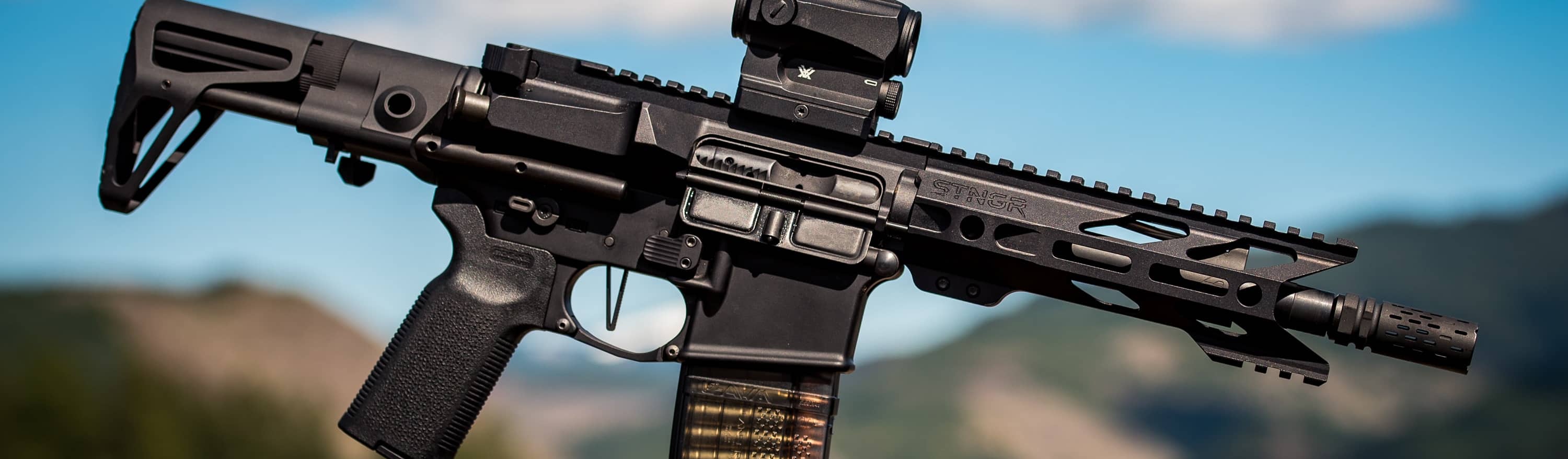
AR 15s are some of the most enjoyable rifles to shoot. They are lightweight, produce very little recoil, and provide us with solid accuracy without breaking the bank. They are semi-auto guns traditionally chambered for 223 ammo or 5.56 ammo. Also called “modern sporting rifles,” over the decades they have also become known as “America’s Rifle.” Even with the simplicity of this platform, there are some fundamentals that are the cornerstones that we should observe. These items will allow us to shoot an AR 15 both correctly and safely. Let’s take a closer look at the fundamentals of how to shoot an AR 15. Before we begin, please remember always to obey the gun safety rules.
Fundamental #1: Holding the Rifle
The first thing we need to look at is how to hold the rifle. There are four points of contact on the gun. First is at the pistol grip. This should be a firm but not crushing grip. In fact, it can be lighter than what you would use with your handgun because you will have several other points of control on the rifle.
Second, there is your hand on the foregrip. Depending on what style of rifle you have or added accessories, there may or may not be a drop-down grip. Regardless, you want to get a firm grip here and drive the gun back into your shoulder to help stabilize the gun.
The third point of contact is at the shoulder. Seat the butt of the rifle into the shoulder area high enough so that when you raise it up, the sights are in line with your eyes.
The final point of contact is what is called the “cheek weld.” This is where you rest your cheek on the stock.
All of these points together allow you to stabilize the gun quite nicely.
Fundamental #2: Get on Sight
Now you want to align the sights. Most ARs have iron sights to begin with, but many owners will install optics as an add-on.
Because we are talking about basics, let’s stick to iron sights. Most ARs with iron sights have the aperture style, also called “peep sights.” The rear sight has a small hole you look through. There might be two different-size holes. The larger one lets you line up the sights quicker; the little one gives you better precision. Close one eye and look through the hole in the rear sight, at the front sight post. Line everything up so the top of the front sight post is right in the center of the target. Unless the target is close, you generally want your vision focused on the front sight. This produces a semi-blurry rear sight, a clear front sight, and a semi-blurry target.
Fundamental #3: Time to Shoot
Once you are on target, you want to take the rifle off of safe and prepare to fire. Use your strong-side thumb and flick the safety switch up to fire. Now slowly press the trigger with consistent pressure toward the rear. A smooth trigger press allows you to keep the gun stable and that, in turn, gives you better accuracy. As the shot fires, keep your head down on the rifle and on the sights.
Let the trigger reset and repeat as necessary. This principle is called “follow through” and allows you to not only be more accurate, but also faster at shooting targets. Once you have fired the shots you need to, use the strong-side thumb again and move the fire selector to safe.
Conclusion
These essential fundamentals can help you become much more effective with your AR 15. As with any advanced skill, it will take time and practice to master. I encourage you to not only practice these points but to seek out professional training as well. The AR 15 is one of the most enjoyable and easy rifles to shoot. Master the basics and enjoy a lifetime of fun range time.
FAQs
Q: What does the AR in AR15 stand for?
A: While called an “assault rifle” in some circles, that term is completely fabricated. AR stands for ArmaLite rifle, named after the company that developed the firearm. It was first used during the Vietnam War as an alternative to the M14 rifle, which was heavy and difficult to control. Over the years, the AR 15 has become one of the most prevalent rifles in use around the world. The original ArmaLite AR 15 is a scaled-down derivative of designer Eugene Stoner's original AR 10 design, which was built to fire the larger 308 round.
Q: Are all AR 15s chambered in 223/5.56?
A: While the most common round we see for the AR 15 is 223/5.56, it can be found in a variety of calibers. They range from a very enjoyable 22LR to 308 and 7.62x39. One of the more popular rounds is 300 Blackout. The AR 15 makes a great platform to run this beefy round with minimal recoil and muzzle rise. A popular option when running 300 Blackout is to shoot it with a suppressed rifle. This provides a very quiet shooting experience, especially when subsonic ammunition is used.
Q: How much does an AR 15 weigh?
A: Rep. Sheila Jackson Lee incorrectly claimed that AR 15 rifles fire 50 cal ammunition and that the firearms are “as heavy as 10 boxes that you might be moving.” This could not be further from the truth. While the actual weight of individual guns will vary because of things such as optics or other add-ons, there is a base we start with. The average unloaded carbine AR 15 with a 16-inch barrel with iron sights, stock, and handguard weighs around 6.5 pounds. Once you add a loaded 30-round magazine of 223/5.56, you will be adding roughly 1 additional pound.
Q: Is the AR 15 a machine gun?
A: This is, once again, an area that those in the anti-gun world try to blur. They often refer to the AR 15 as an automatic weapon or machine gun. This is simply not true. The AR 15 is a semi-automatic rifle that fires one round with each press of the trigger. While its cousin, the M16, is a full-auto gun, the AR 15 is a one-at-a-time gun. Full-auto guns are highly regulated by the ATF and are limited in availability. The rare nature of these guns puts them into the collector category, with a vintage M16 costing in some cases as much as $35,000. This price, coupled with the extensive legal paperwork required to acquire one, makes them a rarity.
Q: What are the major parts of the AR 15?
A: The AR 15 is composed of two specific groups. First is the lower. This is the serial-numbered part that often needs to be purchased from a licensed firearms dealer, depending on state and local laws. The lower is what everything else bolts onto or is built upon. This group houses components such as the trigger, safety, and buttstock assembly. Next, we have the upper. This includes the barrel, bolt carrier group, upper receiver, charging handle, sights, gas system, and muzzle device. Both upper and lower groups can be purchased prebuilt separately or together as a complete rifle. Likewise, both groups can also be pieced together part by part.