



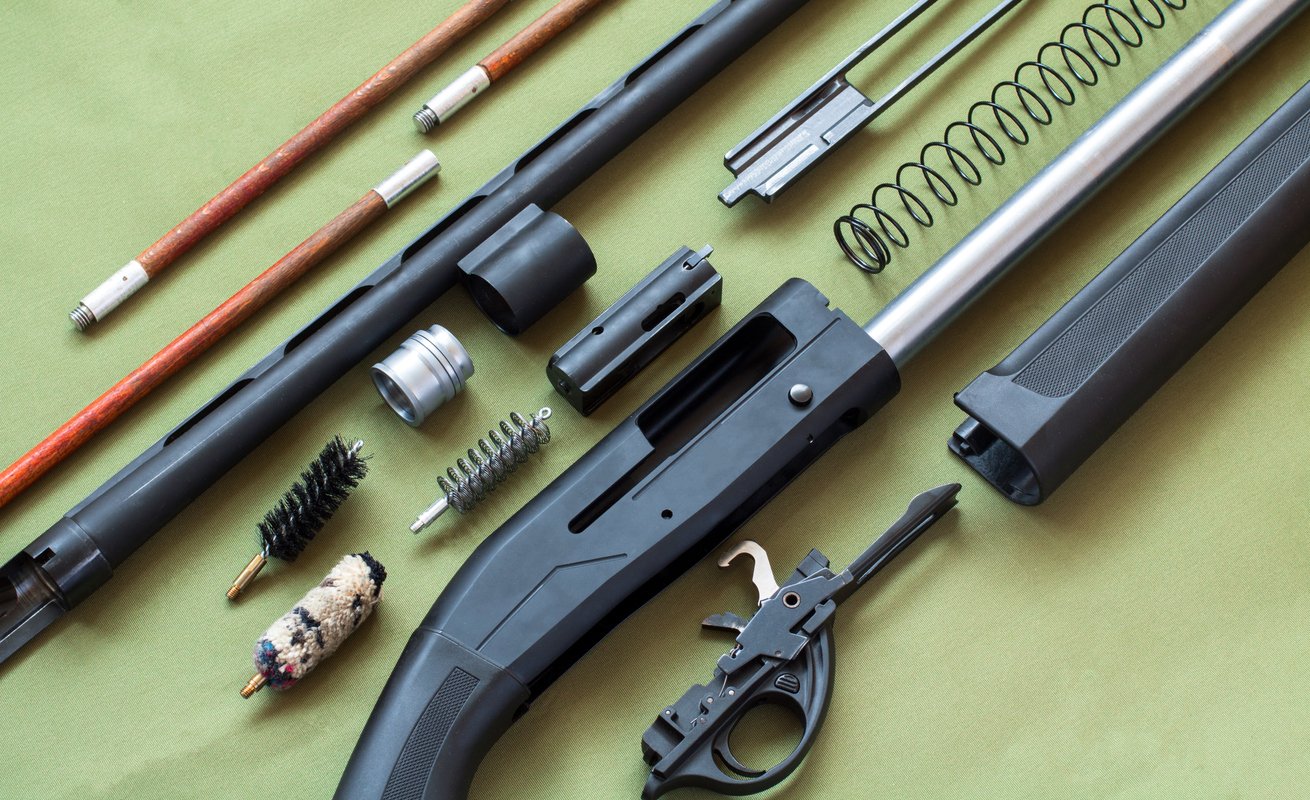
A shotgun can last for generations if you take care of it. Dirty guns rust, malfunction, and wear out. Keeping a shotgun clean means taking a few minutes to wipe it down with an oiled rag after every use, giving it a quick cleaning every few hundred rounds, and doing a thorough takedown at the end of a season. Also, any time a gun starts malfunctioning or gets very wet or muddy, you should take it apart and clean it. Pumps, semi autos, and break actions all demand different cleaning routines.
To clean any shotgun, you will need a cloth, a bore snake and/or cleaning rod, a punch to remove trigger-group pins, and a socket wrench and/or screwdriver in case you need to remove the stock. Pipe cleaners and an old toothbrush can come in handy, and some people use cans of compressed air to blow out debris. You will also need gun oil or a clean-lubricate-protect product such as G96 or Break Free CLP. Grease, such as Shooter’s Choice, and a solvent like Hoppe’s #9 are good to keep on hand, too. A foaming bore cleaner makes cleaning the barrel easier.
Pump Shotguns
Cleaning a pump, like cleaning any shotgun, begins with the barrel. Take off the magazine cap, pull the barrel off the gun, and clean it from the chamber end. Spray foam cleaner into the barrel, let it sit for a few minutes, then run the bore snake through two or three times. Lightly oil the back of the end of the bore snake and run it through again.
Once a year or so, you will need to do a deeper barrel cleaning. Use a rod and bronze brush to scrub thoroughly, paying special attention to the chamber where plastic residue from hulls accumulates. After you use the brush, run a lightly oiled patch through the bore. Remove the choke tube, if the gun has one. Clean its threads and the threads in the muzzle with a brush. Grease the threads and put the tube back. Check your choke tube often, especially if the gun gets wet, or it you may find it rusted in place and impossible to remove without damaging the choke or the barrel.
With the barrel off, you can pull the slide forward, depress the cartridge stops on the inside of the receiver, and take the whole slide/action bar/bolt assembly out. Use a punch and small hammer to drive out the trigger-group pins and remove that assembly.
Wipe the trigger group clean and/or use compressed air to blow off debris. Oil it very lightly, then wipe most of that oil away. Similarly, wipe the bolt and action bars clean. Put a tiny drop of CLP on the firing pin hole and a bit of grease or oil on the action bars. Under-oiling is always better than over-oiling. Oil collects dirt and residue and can clog or wear the gun. I have seen an over-oiled pump gun quit in the middle of a trap shoot. While you have the gun apart, clean out the inside of the receiver as well.
Finally, if you can easily remove the spring retainer at the top of the magazine tube, do so, taking care not to shoot the magazine spring into your eye or across the room. Clean the magazine tube with a brush. If you have an oversize brush—say, the next gauge larger—it should fit the magazine tube. Clean the spring, put the gun back together, and you’re ready to shoot again.
Semi Auto Shotguns
Clean the barrel as you would a pump barrel, with one additional step if your gun is gas-operated, not inertia. Gas guns have ports in the ring that holds the barrel onto the magazine tube. Those ports siphon gas into the action to make the gun cycle. A pipe cleaner dipped in solvent works to clean them. With the barrel off the gun, take any rings and pistons off the magazine tube. Removing the bolt assembly requires removing the bolt handle per instructions in the manual. Some bolt handles must be indexed to a certain place to come out. Clean the gas system parts. Some gas pistons may need to be soaked in solvent to remove carbon buildup. You will also need to scrub carbon off the magazine tube on gas guns with very fine steel wool.
As with the pump gun, pop out trigger-group pins and clean the trigger assembly and bolt, and the inside of the receiver, as well as the magazine tube. It’s rarely necessary to take the bolt all the way down to component parts on semi autos or on pumps. Lightly oil the bolt rails of the gun before you put it back together.
You rarely have to clean the bolt-return spring—especially on newer guns with stainless springs. Unless the gun has been underwater, cleaning the return spring is a once-every-5,000-rounds procedure, and many people recommend changing return springs every 10,000 rounds. You’ll have to remove the recoil pad, usually with a Phillips screwdriver, then remove the stock with a long screwdriver or socket wrench and extension, depending on the type of stock bolt.
You will need to put the gun in some kind of padded vise. Some guns, such as Berettas, have the tube cap held in place with threadlocker and will need to be heated. Some guns have a pin that holds the spring; others have a cap. Remove it carefully. This is a stout spring under pressure. Clean it, clean the inside of the tube with something like a .45-caliber pistol brush, put it back in the gun, and forget about it for a few years.
Break Action Shotguns
Obviously, O/Us and side-by-sides have twice as many barrels to clean, as do pumps and semi autos, but you clean them the same way. Otherwise, they are easier to maintain, as they rarely, if ever, need to be taken all the way apart. Be sure to clean out any crud or debris you find in the receiver after you take the barrels off. You will also have to clean underneath the ejectors/extractors in the breech with a Q-tip or toothbrush.
Break action guns pivot open either on a hinge pin or on trunnions on the sides of the frame. Whenever you clean the bores, also clean the trunnions or hinge pin and wipe away any old grease or oil, then replace it. Pay attention to the gun’s knuckle—the half-round part at the front of the action. Clean it and grease it lightly. If you don’t keep them clean and lubed, trunnions/hinge pin will wear and the knuckle will gall (scratch deeply). Either can shorten the life of the gun and make the action loose.
Because the trigger assembly is enclosed in the stock, it rarely needs attention. Some break-action owners never clean the insides of their guns and experience no problems at all. Removing the stock requires taking off the recoil pad, then removing the stock bolt with a long screwdriver. You can then pull the stock off and clean the trigger, sears, and hammers.
Conclusion
Regular maintenance of your shotgun will keep it in top shape. Cleaning procedures for pumps and semi-auto models are a bit more involved than that for break action guns, but are not too onerous. Dirty guns rust, malfunction, and wear out. Clean guns will last for generations.
FAQs
Q: Why do people say not to use WD-40 for gun cleaning?
WD-40 is not a lubricant. It will stop squeaks and displace water. You can use it to dry a wet gun, but you’re better off never putting it on your gun in the first place. If you do, you’ll have to put a good quality gun oil or CLP on it afterward. Also, over time, WD-40 turns to a gummy sludge that can prevent a firearm from functioning properly. You’ll have to clean that off, then lightly oil the gun.
Q: Is it important to clean a shotgun from the breech end?
A: It is not nearly as important to clean a shotgun from the breech as it is to clean a rifle that way. Unless the shotgun is a rifled deer gun, it will not have a muzzle crown to damage, which a rifle does. The main reason to clean a shotgun from the breech is to ensure that you give the chamber area sufficient attention and remove all built-up plastic deposits. It’s also easier to push a rod or snake through the tapered choke from behind.
Q: Should I clean my choke tube?
A: If a gun gets wet, a choke tube can rust into place, making it difficult, even impossible, to remove. And, if you don’t keep choke tubes clean, powder fouling and plastic from the wads can build up beneath the skirt at the base of the tube. If that happens, the skirt can be damaged such that a wad snags on it. That can destroy the tube and/or launch it out of the gun.
You May Also Like: